Epoxy Resin for Swimming Pools — Why It Is Better Than Tiles
QR Bangladesh Swimming Pool Store supplies professional-grade epoxy resin systems for swimming pools, water tanks, fountains, and wet areas across Bangladesh.
This article explains:
- What epoxy resin is
- Why epoxy coatings outperform tiles in pools
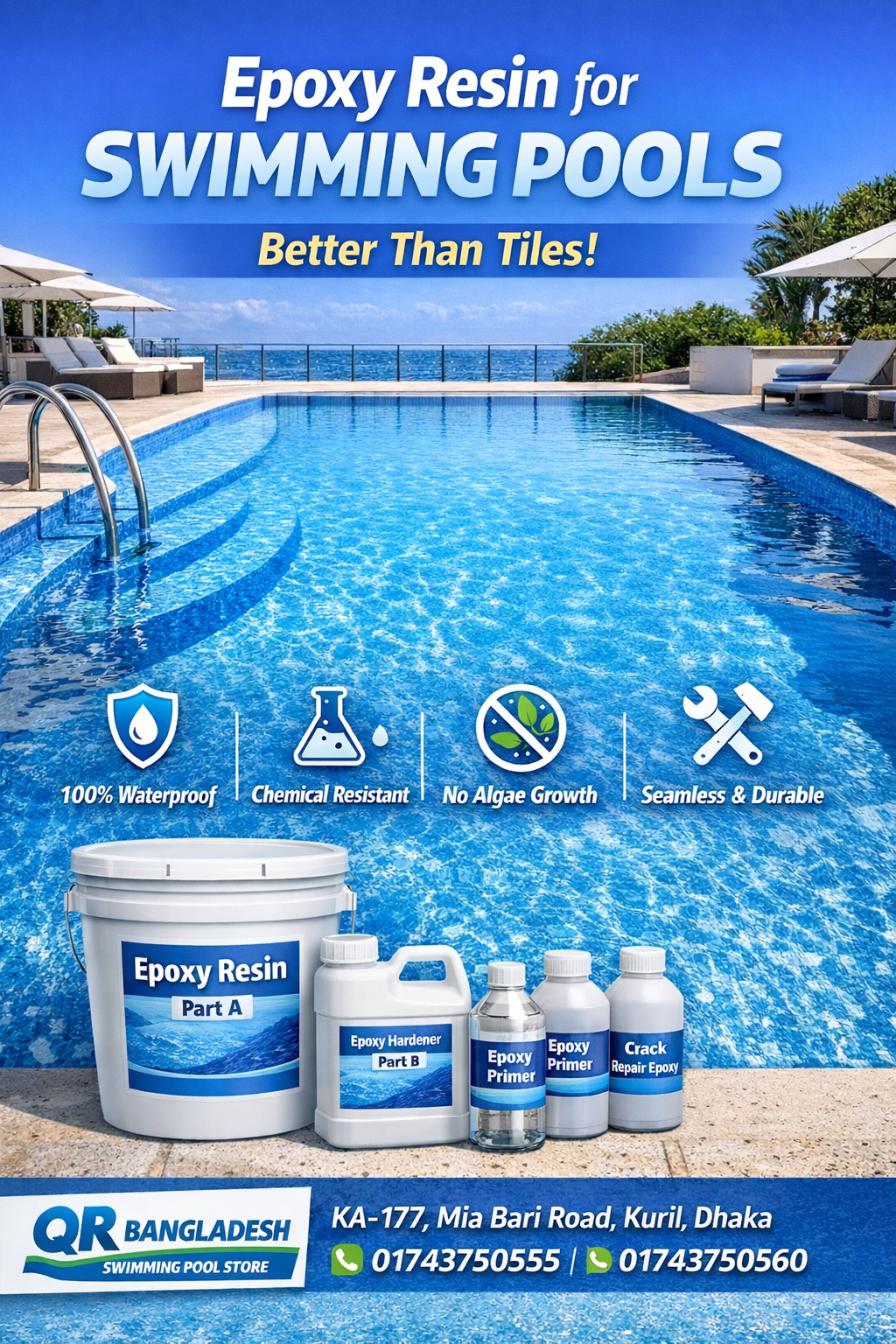
- What complete epoxy solutions QR Bangladesh provides
What is Epoxy Resin for Pools?
Epoxy resin is a two-component coating system (Resin + Hardener) that chemically reacts to form a solid, waterproof, chemical-resistant surface when applied on concrete, plaster, or fiberglass.
This definition is consistent with:
- Encyclopaedia Britannica (Epoxy polymers)
- American Chemistry Council
- ASTM materials standards for thermosetting polymers
After curing, epoxy becomes a hard plastic-like lining bonded directly to the pool shell. It is not paint, and it is not tile grout.
Why Tiles Fail in Swimming Pools
Tiles look beautiful — but in water-filled structures they have structural weaknesses that epoxy does not.
1. Tiles Are Not Waterproof
Tiles themselves are not waterproof — only the grout and adhesive block water. Over time:
- Grout cracks
- Adhesive weakens
- Water enters behind tiles
Once water gets behind tiles, it causes:
- Tile popping
- Hollow sounds
- Leaks
- Algae growth under tiles
This failure mechanism is documented by:
- Tile Council of North America (TCNA)
- International Swimming Pool & Spa Code (ISPSC)
2. Epoxy Is One Continuous Membrane
Epoxy forms one seamless layer — no joints, no grout lines.
This means:
- No water pathways
- No algae behind tiles
- No tile detachment
This property is why epoxy is used in:
- Water treatment plants
- Chemical tanks
- Hospital pools
- Commercial aquatic facilities
3. Chemical Resistance
Swimming pools contain:
- Chlorine
- Acid
- Algaecides
- Salt (for saltwater pools)
Tile grout is chemically weak compared to epoxy.
Epoxy is specifically designed to resist:
- Chlorine
- pH fluctuations
- Cleaning chemicals
This resistance is confirmed in ASTM D543 (Chemical Resistance of Plastics).
4. Hygiene & Algae Control
Tile joints trap:
- Bacteria
- Biofilm
- Dirt
Epoxy surfaces are:
- Smooth
- Non-porous
- Easy to disinfect
That’s why hospital pools and therapy pools often use epoxy instead of tiles.
Why Epoxy Is Better Than Tiles for Pools
| Feature | Tiles | Epoxy Resin |
|---|---|---|
| Waterproof | ❌ Depends on grout | ✅ Fully waterproof |
| Leaks | High risk | Very low |
| Chemical resistance | Medium | Very high |
| Algae growth | In joints | Almost none |
| Maintenance | High | Low |
| Long-term cost | Higher | Lower |
This comparison reflects how materials behave in wet environments — not marketing claims.
Complete Epoxy Pool Solutions from QR Bangladesh
QR Bangladesh Swimming Pool Store supplies all professional epoxy systems required for pool construction and renovation.
1. Epoxy Waterproofing Primer
- Penetrates concrete
- Seals pores
- Creates strong bond for topcoat
Used before all epoxy pool coatings.
2. Epoxy Pool Coating
This is the main pool lining:
- Chlorine-resistant
- Waterproof
- Smooth and hygienic
- Available in multiple colors
Used in:
- Residential pools
- Resort pools
- Therapy pools
- Commercial pools
3. Epoxy Crack & Repair Resin
Used for:
- Hairline cracks
- Structural repairs
- Leak sealing before coating
4. Epoxy Tile-Replacement System
Old tiled pools can be converted to:
Epoxy-lined seamless pools
This removes:
- Grout failures
- Tile popping
- Chronic leaks
5. Epoxy for Balance Tanks, Decks & Overflow Channels
Epoxy is also used in:
- Balance tanks
- Wet decks
- Pump rooms
- Filtration areas
So the entire pool system stays waterproof.
Why QR Bangladesh Uses Epoxy Systems
QR Bangladesh Swimming Pool Store provides epoxy solutions because:
- Tiles fail in tropical water conditions
- Bangladesh has high humidity and thermal movement
- Epoxy performs better in submerged structures
Epoxy Resin for Swimming Pools — Why It Is Better Than Tiles
For more details please visit : Wiki